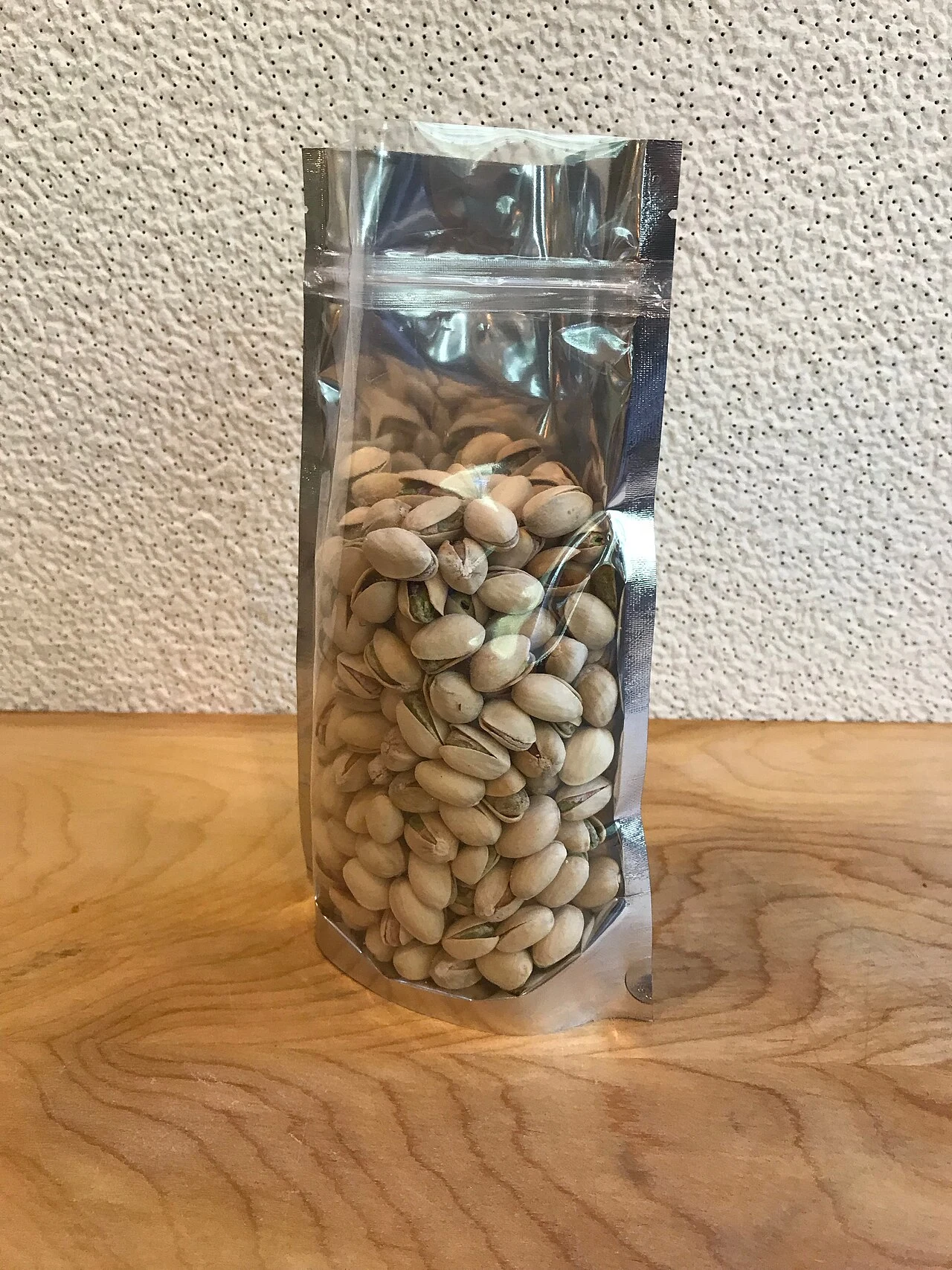
Define the filled product before choosing a pouch size
A stand-up pouch is a flexible container whose useful shape develops with its contents. Its flat width, height, and bottom gusset are important production dimensions, but they do not independently establish usable capacity. The product’s shape, bulk behaviour, filling method, settling, and required access all influence the result. A pouch proposed for a fine powder cannot be approved for irregular pieces solely because the two products share the same declared mass. Likewise, a supplier’s catalogue capacity should be treated as a starting reference with an identified basis, rather than a promise that every product will fit and function in that size.
Start the design brief with the actual product and the amount intended for each sale unit. Describe whether it flows, bridges, settles, clumps, contains projecting pieces, or changes arrangement during handling, where those observations are relevant. Ask the product and production teams to distinguish known behaviour from assumptions. Include the immediate condition during filling, not only the appearance of a finished retail sample. If the commercial team expects several products to share one pouch size, list each application separately. A shared exterior can simplify purchasing, but the suitability of one product does not establish the suitability of every other product.
Include the way the contents will be introduced. A product poured carefully into a development sample may behave differently from product delivered through the actual filling equipment. The filling opening, chute or nozzle arrangement, product movement, and handling between filling and final sealing can affect practical capacity. The responsible technical team should determine which process information matters and how it will be represented. Avoid inventing universal settings or assuming a larger body resolves every problem. More material can create different handling, appearance, and consumer access implications. The relevant question is whether the candidate format supports the real operation and the intended filled presentation.
Define what the customer must do after purchase. A pack intended to be opened once has a different use sequence from one that will be opened, accessed, reclosed, and stored repeatedly. Consider whether the user pours the contents, reaches inside, or uses a separate utensil. These choices influence the opening, zipper position, remaining product accessibility, and the way the pouch stands as it empties. They should be discussed before artwork makes the format appear final. An attractive render cannot demonstrate that the user can reach the last contents or operate a closure when the flexible body changes shape.
The starting record should therefore identify the product revision where relevant, intended fill quantity, representative product behaviour, filling route, desired use sequence, and conditions needing evaluation. Add photographs or sketches when they clarify product geometry, but connect them to the actual sample. Record open assumptions and the person responsible for resolving them. This brief becomes the reference for capacity trials, gusset review, closure selection, and artwork development. It prevents a nominal size chosen early for commercial convenience from quietly becoming an approved specification without evidence that it works for the product and the people who fill and use it.
Establish usable capacity with actual contents and clear arithmetic
Capacity development should distinguish product mass, product volume, and the pouch’s practical filling space. Mass is not volume, and flexible packaging geometry is not a rigid rectangular tank. If bulk density is used to support early estimation, identify how it relates to the actual product condition. A loose fill, a settled fill, and a product with changing particle arrangement may occupy different space. Qualified staff should determine what information is appropriate for the application. The estimate can guide selection of trial sizes, but it should not replace filling real samples and checking the complete closure and handling sequence.
A clearly hypothetical arithmetic example shows the distinction. Suppose an example product has a stated bulk density of 0.5 grams per millilitre under an identified illustrative condition. A 250 gram quantity would occupy 500 millilitres under that same assumption, because 250 divided by 0.5 equals 500. This calculation does not establish the pouch size to buy. It does not account for changing product arrangement, practical filling space, the upper sealing area, zipper access, or the way the bottom forms. Its useful role is to expose the input assumption and provide a starting volume estimate that still needs a physical trial.
Select candidate sizes with the converter and record their drawing references. Fill each with the intended contents using a representative procedure. Observe the product level, the shape of the main panels, the opening remaining available for sealing, and the ability to handle the filled pouch without forcing product into the closure region. Identify any settling step actually used; do not introduce an artificial compression step merely to make a preferred size appear adequate. If the normal filling process includes a defined action, represent and record it. A capacity result is meaningful only when the procedure reflects the application being approved.
Assess underfilling and overfilling as practical behaviours rather than universal numerical categories. A pouch with excessive apparent empty space may not present as intended or may behave differently when gripped. A very full pouch may be awkward to close, may crowd the zipper, or may leave insufficient working space for the final sealing operation. The correct boundary depends on the product and process. Ask the responsible team to define acceptable presentation and function for this project. Avoid using an arbitrary percentage of the bag height as a general rule; flexible shapes and product behaviour make that shortcut unreliable.
Keep the evidence connected to the sale unit. Record the product used, fill quantity, candidate pouch, filling method, observed condition, and decision. If a size is suitable for one quantity but not another, write that distinction explicitly. When a product formula, particle shape, or packing process changes, reconsider the applicability of the capacity trial. A label that retains the same mass does not guarantee the same occupied volume. The final capacity statement should describe a tested application, not claim that nominal dimensions create a guaranteed universal volume for all contents. That distinction helps both supplier and buyer discuss size alternatives accurately.
Read the drawing as a construction map rather than a volume claim
Ask the converter for the actual production drawing and its dimensional conventions. Width and height may be described on a flat finished pouch, while gusset measurements can be expressed in ways that need clarification. Confirm the reference points, the condition in which the pouch is measured, and which areas are available to the contents. A sketch copied from a catalogue may not identify seals, folds, closure positions, or production restrictions. The drawing should make the proposed construction understandable enough to support sampling, artwork, and inspection. It should not be treated as independent proof of filled volume or standing behaviour.
Identify the bottom gusset, side seals, top region, zipper if included, tear feature, and any other relevant geometry. Ask the supplier to explain how those features relate to the usable opening and the finished shape. The stated body height is not necessarily the height available for product because upper closure functions occupy space. Likewise, a nominal width does not explain every internal path through which product must pass. Use the drawing to identify potential conflicts and questions. Then use filled samples to determine how the flexible material and contents actually behave together in the proposed configuration.
Consider dimensional consistency without inventing universal tolerances. The responsible teams should agree what needs to be controlled and how it will be measured for the project. A dimension important to machine handling may require a different measurement discussion from a visual panel alignment. If the buyer supplies a target geometry, ask the converter to identify any adaptation needed for its process. Record that adaptation and review its consequences. Allowing a production drawing to change silently after a buyer’s sketch is approved can create confusion about whether the final sample reflects an agreed development step or an unreviewed substitution.
A clearly hypothetical fit comparison can be useful. Two candidate pouches might share the same overall flat width and height but use different closure positions or bottom arrangements. The matching outer dimensions do not establish matching practical capacity or product access. The correct comparison is between complete identified constructions filled with the same representative contents. This example does not imply that one arrangement is universally better. It shows why a purchasing table containing only three nominal dimensions is incomplete when the design decision depends on how seals, folds, closures, and product interact in the finished package.
Release the drawing together with its sample reference and material identity. If a dimension changes during development, issue an identified revision rather than relying on an informal email instruction. Ask which associated features move or change when the body size is adjusted. Artwork placement, zipper access, tear location, and packed arrangement can all need renewed attention. This is why geometry control belongs in the approval process from the beginning. A good drawing preserves the agreed construction and guides physical evaluation; it does not eliminate the need for that evaluation or convert a flexible shape into a fixed-volume container.
Evaluate the bottom gusset in filled and partly empty conditions
The bottom gusset contributes to the pouch’s formed base, but its presence does not guarantee standing performance in every application. Observe how it opens when the actual product is introduced and how the contents distribute across the bottom. A carefully arranged empty sample may look convincing while providing little evidence about the filled pack. Product shape and flow can influence whether the base forms as intended. The material and local seal geometry also belong to the complete configuration. Ask the converter to explain the proposed design, then evaluate the finished sample rather than relying on the term stand-up alone.
Watch the sequence from filling to placement on a surface. Does the bottom form through the normal packing operation, or does a developer need to shape it by hand in a way that production will not reproduce? Does product remain concentrated in one area? Does the pouch settle differently after routine movement? Record the observations using the intended product and process. The goal is not to create a universal stability test or claim that one gusset depth works for every pack. It is to understand whether the proposed base supports the project’s actual presentation and handling needs.
Assess the pouch at more than one stage of use where repeat access is intended. A full pack, an opened pack, and a partly empty pack can have different shapes and centres of mass. The customer may reclose the zipper, fold the top, or grip the body differently as contents diminish. Define the relevant use situations with the product team and observe them on actual samples. Avoid presenting a single full-pouch photograph as proof of standing throughout the product’s life. A practical limitation discovered during development is easier to address than a broader claim that the design cannot support.
Consider the surface and surrounding environment used for evaluation. The project team should choose conditions relevant to the intended presentation without pretending that one demonstration represents every shelf or household surface. Document what was observed and where. If the pouch leans, twists, or requires support, investigate the product arrangement, base formation, material, and geometry before choosing a correction. Increasing gusset dimensions without understanding the cause can change capacity, print layout, and handling while leaving the original concern unresolved. A useful corrective proposal identifies the mechanism it is intended to address and the sample needed to assess it.
Keep base formation and appearance linked in the sample record. Note whether a candidate meets the intended retail presentation, whether partly empty behaviour has been examined, and what limitations remain. If a different product is introduced into the same pouch, repeat the relevant assessment rather than assuming the base will form identically. If the structure or geometry changes, consider whether earlier observations still apply. The approval should describe the identified filled configuration and use stages that were reviewed. It should not become a guarantee that every package described with the same style name will stand under every condition.
Treat the zipper as a reclosure feature with defined limits
A zipper can make repeated access more convenient, but its function needs to be defined within the complete pouch. Distinguish the initial closing operation from later reclosure by the user. The zipper does not automatically replace the final seal, establish tamper evidence, or prove barrier and leak performance. Ask the supplier to identify the zipper component and attachment arrangement on the drawing. Confirm how it relates to the product opening and the final sealing region. A purchasing description that says zipper pouch without these details leaves important functional and manufacturing questions unanswered.
Assess access with representative contents. The user may need to pour product, place fingers inside, or insert a utensil. The required motion influences the useful opening and the relationship between zipper, tear feature, and body. Check whether flexible material obstructs access or whether product accumulates around the closure in a way that affects operation. These observations are specific to the application. They should not become a claim that a zipper type is universally convenient or unsuitable. The appropriate choice is the one supported by identified samples and relevant use evidence for the actual product and intended sequence.
Observe opening and reclosing after product has been removed. A closure that works on an empty development sample may be harder to manage when the filled body changes shape or product reaches the profile. Identify the actions and product conditions represented in the review. If the team notices incomplete closure or difficulty aligning the feature, record the sample, location, and circumstances. Ask the supplier to explain possible component, attachment, or geometry contributions. Do not assume every issue is a user error, and do not assume a component change is the answer before the surrounding design has been considered.
Confirm that development samples represent the proposed production feature. A different zipper, attachment route, or position may limit what an early sample establishes. Such a sample can still be useful for a layout discussion if its purpose is clear. The approval record should not silently expand that purpose into final functional approval. When a supplier proposes an alternative zipper, request the application-specific basis for equivalence and decide which observations need to be repeated. Matching colour or nominal width is not sufficient evidence that the complete pouch will behave the same during filling, opening, and reclosure.
Link the approved zipper to the material, drawing, product, and relevant evaluation record. Identify who can authorise changes and which questions must be revisited. If reclosure is part of the public product presentation, ensure the wording matches what has actually been assessed. A convenient opening feature can be valuable without supporting broader claims about protection or life after opening. Clear functional boundaries help the buyer avoid overstatement while still making a practical design choice. They also give the supplier a precise target: an identified feature that works within the agreed finished configuration, not an undefined promise of universal performance.
Place tear features around the real opening sequence
The tear feature and the initial sealed region should be considered as part of the user’s first opening sequence. Their positions influence what the customer removes, how the remaining opening is presented, and whether the zipper or other access feature remains usable. Use the converter’s drawing to understand the intended relationship, then assess actual filled samples. A notch shown clearly on a flat render does not demonstrate how the flexible structure will open in the hand. The material, geometry, fill level, and surrounding features all belong to the interaction that needs to be reviewed.
Describe the intended action in practical terms. Where does the user grip, what part is removed, and how does the user know where to begin? The product team should decide which accessibility questions matter for the application and whether specialist input is needed. This guide does not prescribe a universal opening force or imply that one feature suits every user. Qualitative observations can identify difficulties, but they should be recorded accurately rather than converted into unsupported numerical claims. If a particular user requirement is important, establish an appropriate assessment with qualified support and retain its defined scope.
Check the result of opening, not just whether the top separates. Observe the remaining edge, the usable access path, the position of the zipper, and the ability to remove the intended quantity of product. A successful tear that leaves the closure awkward to reach may not satisfy the actual use brief. Likewise, an attractive opening line that conflicts with artwork can create a presentation concern. Review the complete sequence with representative fill levels. If a user normally pours the contents, examine the pouring interaction rather than assuming that convenient finger access is the only relevant question.
Investigate inconsistent behaviour by preserving sample identity and context. Note which structure, drawing, feature position, and product were used. Ask whether the development sample matches planned production and whether any material or conversion change could affect the opening. Avoid making a general judgement about all pouches from one unexplained observation. A corrective proposal should state what changes and how the revised opening will be assessed. If the tear feature moves, review the adjacent artwork, initial seal, zipper access, and remaining body. A local adjustment can affect several parts of the use sequence even when overall dimensions remain unchanged.
At release, include the opening arrangement in the controlled configuration. Keep a representative assembled sample where practical and identify any limitation of the reference. Instructions or symbols on the artwork should correspond to the actual feature and sequence. If the structure, seal arrangement, or closure changes later, consider whether earlier opening evidence remains relevant. The aim is not to promise effortless opening in every circumstance. It is to support the intended application with appropriate observations and clear records, so the first opening is evaluated as a real interaction rather than accepted because a small mark appears on the drawing.
Connect material selection with capacity, sealing, and use
The material structure is part of the pouch design, not an independent purchasing choice added after geometry is approved. It influences the way the body forms, how surfaces are joined, how the pack is handled, and how the intended opening features behave. Request the identified structure and the roles of relevant layers, especially the product-facing sealing surface. Total thickness alone does not establish suitability. A structure used successfully in another product or format may provide useful background, but it does not replace assessment of the actual stand-up pouch configuration and the conditions in which it will be filled and used.
Start material discussion with product sensitivities and filling needs. The responsible technical team should identify relevant protection requirements and review evidence with its sample identity and conditions. Film barrier information is not the same as evidence for the complete pouch with its seals, folds, zipper, and any other interfaces. Do not derive a shelf-life guarantee from a material table or assume that a more complex structure resolves every uncertainty. The material proposal should be connected to the product and finished format, with open questions recorded. This gives the buyer a basis for evaluating alternatives without inventing universal performance targets.
Review mechanical interactions separately from barrier questions. Product corners, moving pieces, rubbing, handling, and the changing shape during use may create relevant concerns. The actual contents and intended sequence should guide representative evaluation. If a candidate pouch changes shape in an undesirable way, investigate whether product arrangement, material, geometry, or process contributes. Request a targeted explanation rather than an unsupported stronger film description. Increasing nominal thickness may alter several characteristics at once. The team needs to understand which concern the change addresses and what evidence will show whether the revised configuration is suitable for the stated application.
The sealing process needs actual production input. Identify who makes each seal and which operation closes the filled pouch. Product in the seal region, local folds, closure components, and handling can influence the result. Qualified staff should choose appropriate line conditions and evaluation methods; there is no universal temperature or speed to copy into every pouch specification. Development samples should be labelled when their seal-making route differs from production. A manually closed sample may be useful for capacity and access review while leaving production sealing open. Keep those conclusions separate so one successful observation does not mask another unresolved question.
Environmental or contact-related statements require their own scope and support. A broad material label does not automatically establish recyclability, product suitability, or compliance for every market and use. Identify the actual construction and components covered by any statement, and obtain appropriate qualified review where necessary. If the material changes during development, reconsider both function and public wording. The approved pouch should therefore be described as a complete product-specific configuration, with material, geometry, closure, process, and evidence linked. This is more useful than treating the structure as a commodity abbreviation that can be substituted while all other approvals are assumed to remain intact.
Design the artwork on the formed pouch and converter drawing
Stand-up pouch artwork must accommodate a flexible shape that changes with filling and use. Begin with the converter’s approved production drawing, showing seals, folds, closure positions, and relevant non-print or restricted regions. Confirm the drawing revision before layout begins. Safe areas, bleed, and production preparation requirements should be provided for the actual process; there is no universal numerical allowance suitable for every pouch. Keep structural and printable information separate so construction marks do not accidentally enter the artwork. The design team needs the same geometry that the supplier will use, rather than a generic template that resembles it.
Decide which information must remain visible on the main display surfaces. Product weight, contents, brand identification, instructions, and any other required information need appropriate review by the responsible people. Check how the panels present when the pouch is filled, when the top is removed, and when the zipper is reclosed. An element centred on a flat panel can appear different after the gusset opens and the body curves. A printed mockup helps reveal panel relationships, but its material and construction limitations should be stated. An attractive presentation model does not automatically represent production appearance or performance.
Pay attention to the bottom region, side seals, zipper area, and opening feature. Important text should not disappear into a fold or be placed where the intended opening sequence removes it unexpectedly. Ask the converter to identify production restrictions rather than inventing a universal clearance. If geometry or closure position changes, reopen the artwork review. The visual file may be unchanged while the finished presentation changes because the underlying structure moved. Keep the artwork and structural revisions linked in the approval record so a designer’s latest file is not paired inadvertently with an obsolete pouch drawing.
Colour, gloss, texture, and print coverage should be reviewed using appropriate references. Screen images and photographs are useful for communication but cannot fully represent every finished surface characteristic. Where appearance is brand critical, agree a physical reference and its limitations. Ask whether the evaluated sample uses the intended substrate, print, and finish. Changes introduced to improve visual presentation may also affect material or process questions, so record them rather than treating them as purely decorative. If codes are included, use appropriate specialist requirements and production-representative evaluation. One successful phone scan does not replace the relevant verification work for the application.
Before release, inspect the assembled orientation and the first-opening sequence with the final artwork reference. Confirm who checks text accuracy, who confirms technical placement, and who authorises the production combination. If the supplier adapts files, identify and review the adapted version. Retain the approved files together with drawing, material, and sample references. This helps investigate later differences without reconstructing an email chain. Artwork approval should mean that the intended information and presentation were reviewed on the relevant geometry, with appearance references understood. It should not be mistaken for a guarantee of capacity, standing behaviour, sealing, or product protection.
Run filling and use trials with a defined evidence plan
A useful trial plan lists the questions each sample is intended to answer. Capacity, gusset formation, final sealing, opening, access, reclosure, and presentation are related but distinct. Some questions can be explored early with a structural sample; others need production-representative material, printing, components, or line conditions. Ask the supplier to declare how each development sample differs from the planned supply. Then decide what can reasonably be concluded from it. This approach makes staged development possible without allowing a convenient early sample to become an unsupported final reference for characteristics it never represented.
Use actual contents where available and identify their revision or condition. If substitutes are needed, record what they represent and where they differ. An equal mass does not necessarily reproduce bulk behaviour, contact, or filling. Define the filling procedure and any normal settling or handling action. Record the candidate pouch and material identity, fill quantity, relevant line information, and observations. If several candidates are compared, keep the sequence clear and note changes between them. Otherwise, a candidate’s apparent improvement may reflect a changed procedure rather than the design itself. Consistent records help the team interpret differences instead of relying on memory.
Observe the pack through the relevant stages rather than ending the review immediately after filling. Check formation and closure, placement, first opening, product removal, and reclosure where intended. Include partly empty behaviour when it matters to the brief. The team should choose proportionate methods and conditions rather than inventing a universal ritual. Where specific integrity, compatibility, transport, or product protection questions are important, obtain appropriate technical assessment. An informal demonstration can identify issues, but it should not be described as proof of every performance requirement. Record the boundary between observed usability and other technical conclusions that remain to be established.
Write findings in a way that supports correction. Identify location, sample, action, and product condition. Instead of stands badly, describe whether the base failed to form during normal filling, whether contents settled to one side, or whether the partly empty pouch behaved differently. Ask the supplier to explain which design or process change addresses the observation. Reassess the corrected candidate against the original question and any new interfaces created. This turns sampling into a learning sequence. It avoids repeated aesthetic revisions that consume time while leaving the actual capacity, closure, or use concern unresolved.
The trial report should state the decision, accepted attributes, open actions, and limitations. Retain labelled samples and relevant photographs where practical. If a sample-only deviation is accepted temporarily, distinguish it from the production requirement. Identify who will close each action and who can release the final configuration. A successful evaluation supports the particular pouch, product, and conditions reviewed. It does not guarantee every future unit or every possible use. Clear boundaries are useful because they show exactly what must be reconsidered when the product, structure, component, or filling operation changes during later commercial development.
Compare supplier proposals and control the delivered configuration
Send suppliers the same product brief, drawing or development objective, fill quantity, use sequence, artwork references, and expected supply scope. If alternatives are welcome, require their differences to be declared. A pouch with a different zipper, seal region, structure, or gusset is not automatically equivalent because its overall width and height match. Ask each proposal to explain what is confirmed, what is assumed, and which evidence is available. This gives purchasing a basis for comparing actual configurations rather than selecting a nominal size and discovering during sampling that suppliers interpreted the functional brief differently.
Separate recurring supply from development, sampling, tooling, printing preparation, and other stated charges. Identify quantity by artwork and clarify whether the supplier is quoting ready-made pouches or another supply arrangement. Packing and delivery scope should be clear. This guide does not invent prices, taxes, duties, or freight rates. The commercial comparison should show inclusions, exclusions, and technical deviations in a readable form. A lower unit number is meaningful only after the pouch configuration and supply boundary are aligned. Important unresolved questions should remain visible rather than disappearing inside a total that appears precise.
Specify identification and packing for the pouches themselves. Finished units need to reach the filling operation without avoidable deformation, surface damage, or confusion between designs. Ask the supplier to show the proposed arrangement, quantity grouping, and outer identification for the actual format. Avoid prescribing universal packing quantities. Material, artwork, component, and production references should connect delivered units to the approved configuration. The receiving and production teams need those identities in practical form. A sound approval record is difficult to use if similar-looking pouches arrive without a reliable link to the order and relevant specification revision.
Obtain relevant storage and handling information for the actual supply. Consider the buyer’s own warehouse and the movement from receiving to the line. If pouches are regrouped or taken out of protective packing internally, that step may matter when investigating later condition. Record planned assumptions rather than relying on a generic storage statement. If the supplier proposes a packing change, review its effect on the finished units and operational access. Packed dimensions and mass used for logistics should be identified as measured or supplier-declared inputs, not estimates that silently become fixed facts in a commercial calculation.
At order placement, reconcile the final quotation with the approved development result. Geometry, material, closure, artwork, and packing may have changed since the first proposal. Confirm that the ordered combination is the one assessed and that any restrictions are understood. Require proposed substitutions to be raised before production, with application-specific justification and a decision on further review. This is particularly important for repeat orders: the commercial description may stay unchanged while a product or component evolves. Controlled supply means preserving the evaluated configuration and reviewing meaningful changes, rather than assuming that a familiar pouch name guarantees the same result indefinitely.
Release an application-specific pouch and manage later changes
The final release package should identify the product application, fill quantity, material structure, production drawing, closure and opening features, artwork, filling reference, relevant evidence, and packing arrangement. It should state which attributes are accepted and which restrictions remain. Not every detail needs a long written description if a controlled drawing or sample communicates it clearly. What matters is consistency and accessibility. The people producing, receiving, filling, and reviewing the pouches should all be able to find the same approved references. A collection of attachments without a clear current version is a weak substitute for an agreed release record.
Assign authority for deviations and final acceptance. Visual, dimensional, and functional questions can need different references and methods. A photograph can locate an appearance concern, a drawing can support dimensional review, and a filled sample can support a discussion of access or base formation. Qualified staff should agree appropriate inspection and evaluation approaches without inventing universal sampling levels or defect limits. A golden sample is a reference, not a guarantee that every delivered unit is perfect. The release decision should explain the evidence available and the responsibilities for ongoing production control and receiving review.
Define changes that trigger reconsideration. Product shape, bulk behaviour, fill quantity, material, zipper, tear feature, bottom construction, seal arrangement, artwork, and filling operation can affect earlier conclusions. The level of reassessment should depend on the interfaces changed. A text correction may need a content review, while a moved closure may require renewed opening and capacity assessment. Do not assume unchanged outer dimensions preserve every functional result. Conversely, do not repeat unrelated work automatically when a targeted technical review can address the uncertainty. Record the decision and its basis so the next team understands why the change was accepted.
If a problem appears in production or use, preserve traceability before choosing a cause. Identify the pouch batch, product, fill quantity, relevant operation, observed location, and sequence. Retain affected and comparison samples where practical. Ask whether the delivered configuration matches the approved one and whether the use matches the evaluated application. Investigate material, geometry, component, and process contributions as appropriate. Corrective action should say what changes and how the result will be checked. Replacing stock without understanding a recurring issue can leave the same design uncertainty in the next order, even if the replacement initially looks better.
A well-developed stand-up pouch is therefore more than a size with a zipper and an attractive front panel. It is a product-specific configuration whose usable capacity, base formation, initial closure, opening, access, and reclosure have been considered together. Its material and process evidence remain tied to their actual scope, and its artwork reflects the formed object. Approval becomes a clear decision about an identified application with documented limits. That gives the buyer a practical route from early volume estimates to controlled supply, while avoiding unsupported promises about standing, shelf life, barrier performance, or leakage that the available evidence does not establish.
Continue exploring
- Quality planning
- Product library
- Start a project
- Flexible packaging structures: start with product needs
- Rollstock film specifications for packing-line trials
- Stand-up pouches
- Food packaging pouches
Technical guidance for project planning; verify specifications and applicable requirements for your product and market.